
The post 4 Benefits of Living In a Garden-Style or Park-Style Apartment appeared first on Kelmscott Park Apartments Blog.
]]>We take immense pride in our apartment buildings. We also know that besides the apartments themselves, it’s important to think about the environment and surroundings of those apartments. This is why at Kelmscott Park Apartments we love the idea of creating a park-style setting for our residents in Lake Forest. With beautiful gardens designed by Mariani, we have created the feeling of visiting a park right here at home.
Here are four benefits of living in a park-style setting.
Nature Relieves Stress
Science has already shown that nature has the healing power to soothe and relieve stress. We get a sense of calm by breathing in fresh air and seeing the colors of mother nature around us. By bringing this park-like setting to our residents, we make it easy to wake up to beautiful scenery or relieve stress with a walk through our gardens.
Community Matters
When you are new to a town or area and you want to make friends, it can be hard to talk to someone in the few seconds you have on an elevator or passing them in the halls. Going outside and being in the open air makes it easier to mingle with people on the lawn or sit outside by our outdoor grilling station and make new friends. There’s nothing quite like sitting by the fire at sunset with friends.
Pets Have Room to Roam
Animals can get stressed out in close quarters or on busy city sidewalks. We all know our canine friends love the park, so having one right outside makes it that much easier to take your dog for a walk or meet other dog friends out on the lawn. When your dog is happy, so are you.
A Cooler Environment
Having greenery and grass surrounding an apartment cools the area much better than asphalt or even dirt and cement. It insulates the ground rather than heating the way asphalt does, giving you more comfort in the hot summer months. This also creates a cooler space for you and your pet to enjoy the nice weather without overheating.
Why do you love living in a park-like setting? Tell us in the comments!
The post 4 Benefits of Living In a Garden-Style or Park-Style Apartment appeared first on Kelmscott Park Apartments Blog.
]]>The post How to Plant a Patio Garden for Your Apartment appeared first on Kelmscott Park Apartments Blog.
]]>With innovative pots and planters that have self-watering reservoirs, it's easier than ever to grow fresh food right at your doorstep, whether it's a roomy patio, a wide front stoop or a compact balcony. Instead of digging a garden in the earth, plant a crazy quilt of herbs, flowers and vegetables in a collection of containers. By using elevated raised beds — where the planting surface is several feet off the ground — you can water, weed and harvest without bending over.
Location, Location, Location
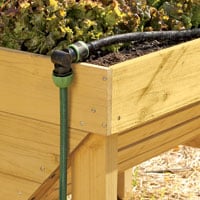 Snip-n-Drip soaker systems can be customized to fit any planter.
Start by looking for the best site. Do you have enough sun? To do well, most edible crops require at least six to eight hours of direct sun a day, especially tomatoes and peppers. With less sun, consider growing salad greens, which do fine with fewer hours of sunlight. Keep in mind that your best "doorstep" for edible crops might be the front door. By selecting functional, decorative planters and making careful plant choices, you can still have a front entry that is ornamental and edible.
Another key consideration is water. Make sure watering will be convenient and easy. Even with self-watering planters, you will need to water frequently during the hottest part of the summer. For larger planters, such as elevated raised beds, consider using soaker hose systems for thorough, efficient watering.
Soil Matters
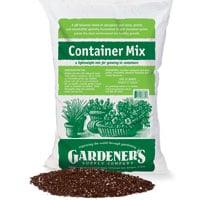 Container Mix is a lightweight planting mix that contains sphagnum peat, perlite and vermiculite to retain moisture without clumping or getting heavy.
Many longtime gardeners say that soil is one of the most important parts of a successful garden. The same is true for gardens in pots and planters, but the approach is different. Typical garden soil — even if it's fertile — is not the best option for pots, planters and raised beds because it doesn't drain well. To ensure good drainage, you need a planting mix that holds and releases moisture as it is needed by your plants. Typical "potting soil" is one option, but it's better to choose a mix that's designed for planters.
When vegetables are grown in pots and planters, regular fertilization is crucial because most planting mixes are fairly sterile. Start with a granular fertilizer that gets mixed into the soil and follow up with regular applications of a liquid fertilizer as your plants begin rapid growth. Depending on the size of the planter, it's a good idea to start each year with fresh planting mix. With larger pots and planters, it might be impractical to replace the planting mix each year, so use a granular "booster" that will recharge the existing mix with vital nutrients and soil conditioners.
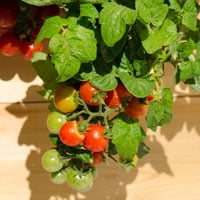 Cascade, a new variety of cherry tomato, is well-suited to compact growing conditions. For more like it, read Top Crops for Compact Gardens.
What to Plant
Choose crops that fit the scale of your container. For instance, a full-size cherry tomato plant can overwhelm a planter and sprawl upon its neighbors. Better to choose a variety that's more suited to compact gardens. When it comes to tomatoes, look for "patio" varieties, which mature early and remain compact. When the tomato harvest is over, you can pull the plant and fill the gap with a crop of late-season lettuce.
When combining plants in the same container, select a variety of heights, textures and colors for an effective display: place the taller plants in the center, mid-sized around the core with shorter plants along the edges to maximize the space. One of my secrets: Start with transplants instead of growing from seed. That way, you get a jump on the season.
To keep planters overflowing with healthy plants, consider a succession of edibles that will stretch out the season. For instance, sow seeds between plants that will emerge as other crops mature and die back. Make a list of "succession crops" by season — early, midseason and late — so you know when to sow seeds. Choose crops that grow quickly from seed, such as basil, dill, chervil, mesclun greens or nasturtiums. For more on succession crops, read Double Your Harvest with Second Plantings
And finally, think about what you love to eat, your favorite colors and what you can't find at your local market. Love to cook Asian cuisine? Grow a few Thai eggplants surrounded by cilantro. Love basil? Grow aromatic cinnamon, lemon or lime basil alongside the traditional Italian sweet basil.
Related Articles
- Top Crops for Small Vegetable Gardens
- Growing Vegetables in Pots and Planters
- Grow Carrots in a Grow Bag
Where to Plant
When selecting containers, you can start with just a few pots and add more each year until you have a clustered container garden, filled with fresh food all summer long. Keep in mind that smaller pots will dry out frequently, so select to planters that hold at decent amount of planting mix, roughly 12 inches in diameter or larger. Planters with self-watering reservoirs will really help reduce watering frequency, and even ordinary pots can be converted to self-watering planters with a self-watering conversion kit. Whatever pot you choose, make sure it has drainage holes.
Another option is to start with elevated raised beds, where you can make use of square-foot gardening techniques. Because they are larger, you have more room to design an ornamental-edible garden. Many of the beds are designed to accommodate frames and covers that protect crops from pests, disease or intense sun. For design ideas that use the square-foot concept, see Planting Plans for the Elevated Cedar Raised Beds. Or, use the Kitchen Garden Planner, our free, online design tool.
To get you started, here are some container combinations, designed to fit some of the innovative planters from Gardener's Supply.
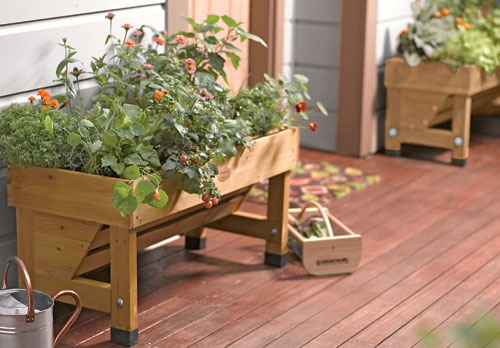
Trough VegTrug: Place this near a sunny dooryard and fill with aromatic culinary herbs, such as cilantro, dill, basil, sage, thyme, tarragon, parsley and chervil.
This new addition to the Vegtrug line is 20" high, with a flat back that can be placed against a wall. It's deeper in back for large plants, such as tomatoes, and shallower in front for smaller plants, such as greens, herbs or cascading vegetables and flowers.
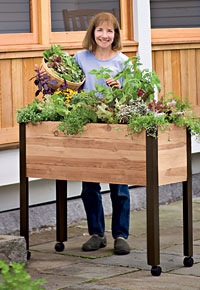 Standing Garden
Standing Garden: This waist-high planter is ideal for the mid-sized vegetables that don't require a wide berth. Try purple bush beans, artichokes and Thai peppers. Create a border with Pistou basil, a miniature variety, alternating with Lemon Gem marigolds, a variety with edible flower petals.
This elevated garden has sides of rot-resistant cedar and aluminum legs with casters, so you can move it easily. A 4-gallon self-watering reservoir keeps the soil moist with less-frequent watering. At 10-1/2" deep, it accommodates large plants, even root crops.
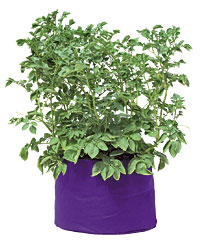
Grow Bags: These are best for those space hogs that are not especially ornamental, such as tomatoes, peppers and potatoes. I've seen these growing on front steps of city apartments, balconies and alongside a driveway. I even know a gardener who fills the back of his pick-up and has a traveling garden.
Grow Bags are available in several sizes, designed to fit various crops, including tomatoes, potatoes and peppers. The porous fabric aerates roots, prevents heat build-up and allows excess water to drain away.
The post How to Plant a Patio Garden for Your Apartment appeared first on Kelmscott Park Apartments Blog.
]]>